



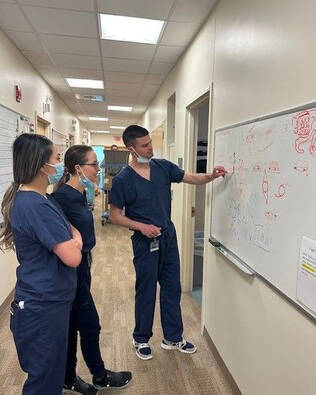
The Micrographic Surgery and Dermatologic Oncology Fellowship provides comprehensive training in Mohs micrographic surgery, cutaneous oncology, advanced reconstruction, histopathology, multidisciplinary care, and academic dermatologic surgery.
Our fellowship is designed to provide fellows with extensive surgical experience while fostering the development of clinical judgment, leadership skills, multidisciplinary collaboration, and academic growth.
An important feature of our curriculum is a strong emphasis on longitudinal patient care, progressive surgical autonomy, and multidisciplinary management of patients with both common and complex cutaneous malignancies.
In addition to core Mohs surgery and reconstructive training, our program includes structured experiences in head and neck surgery, oculoplastic surgery, plastic surgery, cosmetic dermatologic surgery, laboratory management, quality improvement, and multidisciplinary tumor board participation.
Fellows also receive dedicated training in frozen section histopathology interpretation, laboratory operations, reconstructive planning, surgical safety, and systems-based practice.
Clinical and surgical training
The fellowship provides immersive training for physicians pursuing careers in academic medicine or clinical practice in micrographic surgery and cutaneous oncology.
Training emphasizes progressive responsibility and autonomy throughout the fellowship year while maintaining close mentorship and supervision from faculty.
The fellowship includes:
- High-volume Mohs micrographic surgery experience
- Extensive facial reconstruction training
- Frozen section histopathology interpretation and laboratory management
- Longitudinal patient care and continuity experiences
- Dedicated multidisciplinary oncology exposure
- Quality improvement and patient safety initiatives
- Research and scholarly activities
- Resident and medical student teaching opportunities
Fellows participate in approximately 1,000 to 1,200 Mohs micrographic surgery cases annually and actively participate in reconstructive planning and execution across a wide range of complexity.
Multidisciplinary cutaneous oncology experience
Patients with cutaneous malignancies frequently require coordinated multidisciplinary care. Therefore, a major strength of our fellowship is structured exposure to collaborative management of complex oncologic patients.
Structured multidisciplinary experiences include:
- Head and neck surgery
- Oculoplastic surgery
- Plastic and reconstructive surgery
- Radiation oncology
- Medical oncology
- Dermatopathology
Fellows participate in multidisciplinary tumor boards and gain experience managing patients requiring multimodality treatment approaches.
Reconstruction and surgical education
Reconstructive education is integrated throughout the fellowship and emphasizes both technical excellence and surgical decision making.
Fellows develop expertise in:
- Linear repairs
- Local flaps
- Full-thickness skin grafts
- Staged reconstruction
- Interpolation flaps
- Periocular reconstruction
- Complex facial reconstruction
Graduated autonomy allows fellows to develop confidence in both surgical execution and independent reconstructive planning.
Histopathology and laboratory training
A dedicated component of fellowship training focuses on developing competency in Mohs histopathology and laboratory management.
Training includes:
- Tissue processing and embedding
- Frozen section preparation
- Histopathologic interpretation
- Tumor mapping
- Laboratory quality improvement
- Regulatory and compliance principles
- Laboratory leadership and management
The goal of this curriculum is to prepare fellows for future leadership roles within Mohs laboratories and surgical practices.
Academic development and scholarship
Fellows are active participants in the academic mission of the Department of Dermatology.
Academic experiences include:
- Structured didactic curriculum
- Journal clubs
- Quality improvement initiatives
- Research and scholarly activity
- Resident teaching
- National meeting participation
- Multidisciplinary educational conferences
Graduates leave the fellowship prepared for careers in academic medicine, multidisciplinary oncology programs, and independent clinical practice.
Life in the Upper Valley
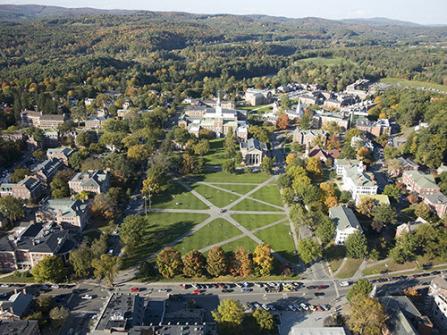
The Upper Connecticut River Valley area of central New Hampshire and Vermont includes the towns of Hanover and Lebanon, New Hampshire. Known as "The Upper Valley," this region attracts people from around the world for its scenic beauty.
The Upper Valley area offers a wide variety of cultural and recreational activities for people of all ages.