


PGY-1
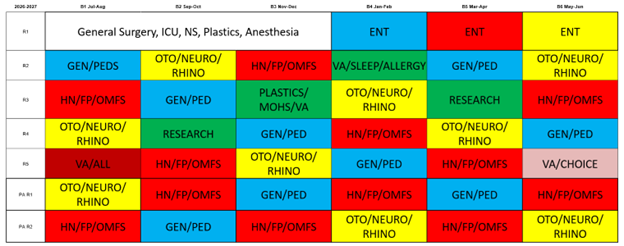
The first nine months of PGY-1 training begins with six one-month blocks in Critical Care/ICU, NET, Neurosurgery, Plastic Surgery, Trauma, and Anesthesia with three blocks of ENT interspersed. Remaining three months of the PGY-1 year are spent on the Otolaryngology service. During that period, the intern will perform as a junior Otolaryngology resident with an emphasis on evaluating Otolaryngologic emergencies, learning to perform tracheotomies, and assisting in the operating room.
PGY-2
The PGY-2 year rotates four months on General Otolaryngology/Pediatric Otolaryngology, two months on Head and Neck Oncology/Facial Plastics/OMFS, and four months in Otology/Neurotology/Rhinology. The PGY-2 has two months off-service when he/she rotates with the Allergy and Sleep Medicine services. The PGY-2 resident is immediately immersed in both the operating room and clinic settings, working one-on-one with the respective attending physician(s). The schedule is designed to provide continuity of care, allowing the resident to participate in pre-operative and post-operative clinic encounters, as well as the surgical procedure and immediate peri-operative care. Together with the PGY-3, the PGY-2 resident shares day call for inpatient/ER consultations.
PGY-3
The PGY-3 year begins with a 2-month block in Head and Neck Oncology/Facial Plastics/OMFS and then two months on General/Pediatric Otolaryngology. The PGY-3 resident has his/her first off service block rotating with the Mohs Surgery and Plastic Surgery teams. The remainder of the year is spent as 2-month blocks in Otology/Neurotology/Rhinology, Research, and Head and Neck Oncology/Facial Plastics/OMFS again. The research block is dedicated to the ongoing development and implementation of his/her clinical or basic science research project. This is the first block of protected research time – an additional 2-month block of research time is scheduled in the PGY-4 year.
PGY-4
The PGY-4 year begins with a 2-month block on Otology/Neurotology/Rhinology followed by Research and then General Otolaryngology/Pediatric Otolaryngology. The last six months include two month rotations on all of the ENT subspecialty blocks: Head and Neck Oncology/Facial Plastics/OMFS, Otology/Neurotology/Rhinology and General Otolaryngology/Pediatric Otolaryngology.
PGY-5
The Chief Resident leads the house staff team. The PGY-5 year is divided into 2-month blocks on the major subspecialty services of Otology/Neurotology/Rhinology, Head and Neck Oncology/Facial Plastics/OMFSx2, and General Otolaryngology/Pediatric Otolaryngology. In block one, the Chief Resident is the overseer of all services, and in block six, the Chief Resident has a “choice” of what service or cases to cover. In addition, the Chief Resident runs his/her own continuity clinic one half-day per week, preparing him/her for efficient independent practice.
The PGY-2 through PGY-5 residents also participate in surgeries during their off service and research blocks at the VA Medical Center in White River Junction to expand and enhance their operative experience.